
In today’s competitive product landscape, innovation is no longer driven by ideas alone. It is defined by execution. For brands operating in performance-driven, design-sensitive markets, the difference between a good product and a breakthrough one often lies in how materials are joined, shaped, and integrated.
At the heart of this evolution is advanced bonding, a seamless manufacturing technology, and a manufacturing partner, such as PD Garment, capable of turning complex concepts into scalable, repeatable realities.
Let’s talk some examples here…
Muscle Containment Stamping (MCS) technology:

PD Garment masters this technology. The product above shows PD Garment’s expertise in integrating MCS into performance legwear, using bonding, not as a secondary process, but as a core design element.
What stands out immediately is not just the graphic pattern, but how it is constructed and positioned.
Precision Placement Driven by Biomechanics
In this example, our PD Garment Design team, co-creating with our customer, made sure the stamped, bonded zones follow the natural anatomy of the upper leg, wrapping around key muscle groups rather than cutting across them. This indicates a development process informed by a detailed understanding of muscle movement during running, where impact, vibration, and repetitive load contribute directly to fatigue.
Instead of relying on uniform compression, MCS allows for targeted containment:
- Structured zones are placed where muscles experience the highest oscillation
- Flexibility is preserved in adjacent areas to avoid restriction
- Support is directional, aligning with muscle movement rather than opposing it
This level of precision cannot be achieved through traditional cut-and-sew methods alone.
Extending Bonded Innovation Across Activewear and Swimwear


PD Garment didn’t associate advanced bonding and ultrasonic technologies only with performance underwear but used them in multiple cross-category applications. The products showcased above are just an example of PD Garment’s use of precision bonding, laminated materials, and ergonomic panel engineering in Activewear and Swimwear, without compromising comfort, durability, or performance.

When PD Garment calls the Intimates category “Our Cup of Tea”, they literally mean it. Every little detail matters as they venture into new innovations.
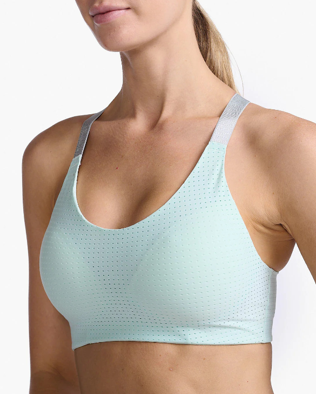
If we take the bra above as a case in point, the photo highlights how fabric engineering and bonding work together to solve real performance challenges.
From the image, several key innovations are immediately visible:
- Perforated zones around the cup, designed to accelerate water drainage and enable faster drying
- High-performance laminated fabrics, providing structure without excessive bulk
- A clean, seam-minimized appearance enabled by ultrasonic bonded cup panels
This construction reduces material layering while maintaining support, demonstrating how bonding technology can replace traditional stitching to create lighter, more efficient garments. The result is apparel that performs consistently in both wet and dry conditions; a critical requirement for modern activewear and crossover products.
Ultrasonic Cup Panels: Support Without Bulk

Another example of PD Garment’s innovative work with some of the beloved brands out there is shown here. The close-up detail reveals ultrasonic-formed cup panels, engineered to minimize bulk while maximizing support and reducing bounce. Instead of relying on thick foam or complex sewn assemblies, structure is created through precise panel shaping and bonding.
This approach offers clear advantages for PD Garment’s partners:
- Reduced garment weight
- Improved comfort and flexibility
- A smoother, more premium internal finish
- Greater design freedom across multiple product categories
Importantly, this same technology platform can be adapted to sports bras, active tops, swim tops, and hybrid performance products, allowing brands to maintain a consistent technical DNA across collections.
From Activewear to Swimwear: Technology That Adapts

Bonded and laminated constructions become even more critical in swimwear, where water resistance, flexibility, and hydrodynamics directly impact performance.
A clear example of this adaptability is the Propel Swimskin, developed by PD Garment in close collaboration with our customer. This product demonstrates how activewear bonding expertise translates seamlessly into high-performance swim applications.
The Propel Swimskin was engineered with a focus on speed, efficiency, and unrestricted movement. Key features include:
- An ergonomically engineered panel layout, designed to follow the swimmer’s natural body position and movement patterns
- Minimal water resistance, achieved through smooth bonded seams and reduced surface disruption
- A hydrophobic coating, helping water shed quickly from the fabric
- High-tech bonded seam construction, eliminating traditional stitched seams that can create drag
- An auto-locking zipper, providing secure closure without compromising hydrodynamics
What makes this product especially significant is not just the feature set, but the development process behind it. The swimskin was created through close collaboration, combining performance requirements, material expertise, and advanced bonding capabilities to deliver a premium, competition-ready solution.
With that said, and from fast-drying activewear to hydrodynamic swimwear, advanced bonding and seamless construction, there is so much, much more to talk about! But let’s discuss more examples of PD Garment’s innovations in future posts.
For Now, Let’s Innovate Together
Leave a Reply